10 Years of The Auckland Co-Design Lab
June 2026
The Lab
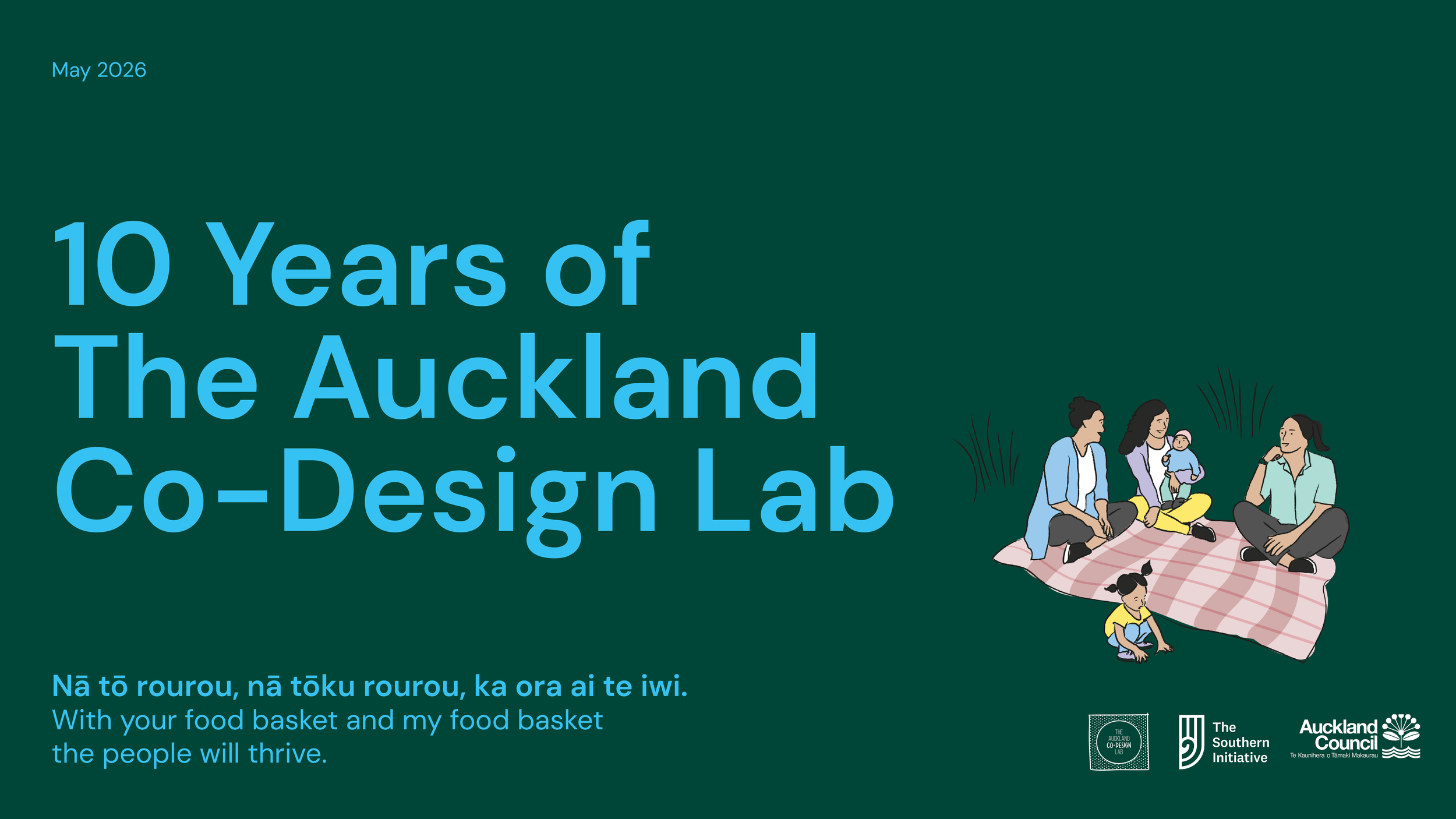
In 2025, The Auckland Co-Design Lab marked 10 years as an Aotearoa New Zealand public sector innovation initiative.
The Lab was established to test innovative, participatory and collective approaches to systemic and complex socio-economic challenges, working in collaboration with The Southern Initiative. Over this time The Lab has evolved from an initial two year proof of concept to a sustained system innovation platform that plays a deliberate and distinctive role within the public sector — demonstrating new practice, building evidence, and strengthening capability and networks to improve outcomes for whānau and hapori.
To mark this milestone, we have released a new report reflecting on a decade of work and learning about system level innovation to address complex challenges — and what will be required in the decade ahead.
One of the clearest lessons from this work is that enduring change cannot be delivered through programmes alone.
The challenges facing whānau and hapori are becoming increasingly complex, while the systems intended to support them face growing pressure and constraint. Responding effectively requires more than isolated initiatives or short-term interventions. It requires systems that can learn, adapt and respond to complexity in ways that are grounded in place and connected to the realities of communities.
Over the last decade The Lab’s work alongside whānau, The Southern Initiative, partners in South Auckland and across the motu, has demonstrated the value of place-based approaches that build from the strengths, know-how, aspirations and lived realities of whānau and hapori. It has also highlighted the importance of connecting local insight with national decision making — ensuring policy, investment and public sector practice are informed by what is happening on the ground and shaped to amplify what matters.
The report also reflects on how The Lab’s methodology has evolved over time. While co-design initially created space for lived experience, collaboration and experimentation, the approach was quickly reshaped by Māori and Pacific practitioners in South Auckland. Practice moved beyond imported innovation methods toward approaches grounded in Mātauranga Māori and Indigenous knowledge systems, connected to place, relationships, and local context.
This shift has shaped how The Lab understands the nature of innovation and what it takes to change how the public sector operates to enable better outcomes — strengthening relational, strengths-based and adaptive ways of working, while supporting learning and adaptation across multiple levels of the system simultaneously. It has also enabled different forms of evidence, knowledge and expertise to be held together in ways that are grounded in tikanga, context and lived experience.
Looking ahead, the opportunity is to apply these lessons more deliberately across the public sector.
This means:
deepening understanding and application of mātauranga Māori and Indigenous-led knowledge and perspectives;
strengthening place-based approaches and locally-led leadership;
building stronger connections between local insight and national policy and investment;
and supporting collective learning and adaptation across public institutions.
If the first decade of The Lab was about demonstrating what is possible, the next is about making these ways of working more common across the public sector. The opportunity now is to build the confidence, capability and conditions needed to work differently alongside whānau and hapori — creating systems that can learn, adapt and respond to complexity over time.
Over the coming months, we look forward to continuing this conversation by sharing the stories, insights and learning from this piece in different ways and places.