

Applying Niho Taniwha
Niho Taniwha supports teams to embed an active learning system. Explore the resources below to support your Niho Taniwha practice, deepen your understanding of the framework, and consider how it might work within your own context.

Niho Taniwha Tools and Practices
-
![]()
Te Whāriki
Tools and practices to support the exploration of different worldviews and starting points of learning partners.
-
![]()
Wāhi Ako Tuatahi
Tools and practices to support active learning with whānau and kaimahi across multiple sites.
-
![]()
Wāhi Ako Tuarua
Tools and practices to support active learning with kaimahi across the system.
-
![]()
Wāhi Ako Tuatoru
Tools and practices to support active learning with kaimahi who have influence over systems levers and conditions.
-
![]()
Niho Taniwha Practice Guide
Suggested practices for teams who wish to implement the Niho Taniwha framework.
-
![]()
Discover if Niho Taniwha is for you
Understand when, how and in what contexts the Niho Taniwha framework may be useful for you and your tīma.
-
![]()
Starting your Niho Taniwha journey
Build your understanding of the framework, its language and the skills and capabilities that support its meaningful application in practice.






Discover if Niho Taniwha is right for you
Niho Taniwha provides an infrastructure for system-wide learning by connecting the different levels and points where change must occur. It also supports a strong focus on system levers such as commissioning, measurement, and workforce capability, as critical targets and points to track change.
Read more about what Niho Taniwha enables us to do here [LINK].
Baseline Practices
Within your consideration of applying the Niho Taniwha framework, these baseline practices are a great place to start. They describe when and how Niho Taniwha is useful, so you can consider whether it fits you and your team.
The readiness prompts below may also be helpful when deciding if Niho Taniwha is right for you, your team and context.
Consider your readiness
You've explored the baseline practices and are considering how Niho Taniwha might be applied in your work.
The following prompts invite you to reflect on your readiness, explore what might be needed, and identify opportunities to begin applying Niho Taniwha within your context. You can work through them individually or alongside your team.
There are no right or wrong answers. These prompts are intended to encourage reflection and help you identify possible next steps, whether that's deepening your understanding of Niho Taniwha, strengthening relationships, or seeking further guidance.
-
What support for Mātauranga Māori capability is currently available to you?
How are Māori leaders, practitioners and whānau currently involved in decision making processes within your mahi or kaupapa?
-
What existing relationships with whānau and hapori are you holding?
Is your mahi grounded in a particular place? How is this connection upheld?
-
Is there support to adjust how you work as you learn?
What opportunities exist to test changes in the system based on collective learning and insights?
-
How are you (and your team) currently giving effect to Te Tiriti o Waitangi, and what would you want Niho Taniwha to strengthen?
-
How comfortable are you (and your team) with learning as you go, changing course and sharing what isn’t working along the way?
-
Embedding a learning system is a journey that takes time, resource and energy. How much capacity do you have for this over the next 6-12 months?
Following an exploration of the baseline practices and readiness prompts, your next steps will hopefully become clearer, however if you'd like to talk through what Niho Taniwha could look like in your context, get in touch — we'd love to kōrero.
Starting your Niho Taniwha journey
Niho Taniwha brings together a range of interconnected elements, practices. It can take time to understand how these fit together, particularly as the framework can be applied in different ways across different contexts.
This section introduces the key elements and concepts of Niho Taniwha, becoming familiar with these foundations can help make sense of the framework as a whole and support you to consider how it might be applied in your own context.
Niho Taniwha is not a one-size-fits-all approach. The intention is not to follow a prescribed formula, but to understand the framework's underlying concepts and draw on them in ways that respond to your unique context, relationships and aspirations for change.
Key elements of Niho Taniwha
Niho Taniwha brings together several key elements that support the activation of a coherent learning system.
Read a brief description of each, or explore them in depth in this section of the Niho Taniwha Introduction [LINK]
-
The habit of pausing to understand why things happened, not just noting what was done.
-
Moving beyond a compliance mindset and asking questions that point the work forward, such as what is needed to make change possible.
-
Blending qualitative stories and quantitative indicators to identify patterns and draw grounded conclusions. Some existing data competence helps.
-
Building the trust needed for work with whānau and partners to land well. Teams show varying levels of readiness in this space.
-
Creating spaces where teams can be open, navigate tension, and surface real insights.
-
Engaging respectfully, cultural awareness, etc.
-
Understanding how daily actions link to wider shifts in practice, policy, or funding.
-
The foundation of the Niho Taniwha framework.
-
In Niho Taniwha, Wāhi Ako are shared learning spaces where teams reflect on emerging knowledge from different parts of the system.
There are three Wāhi Ako or learning spaces within the framework.
-
Niho Taniwha is grounded in relational practice, recognising that meaningful change begins with strong, trusted and respectful relationships.
Three interconnected concepts surround the framework: Whakawhanaungatanga, Relationships and Va.
-
The roles of Niho Taniwha include:
Niho Tapahi
Niho Kōhari
Niho Kata
-
Item description
Capabilities to support your practice
Applying Niho Taniwha well depends on a combination of practitioner skills, organisational conditions, and the ability to weave these together into a coherent learning system.
Practitioners who have had success with Niho Taniwha have repeatedly told us that these capabilities were “enablers” of effective implementation.
They include interpersonal, relational and analytical skills that allow teams to learn, adapt and make the necessary shifts to enable more equitable whānau outcomes.


Te Whāriki
The foundation
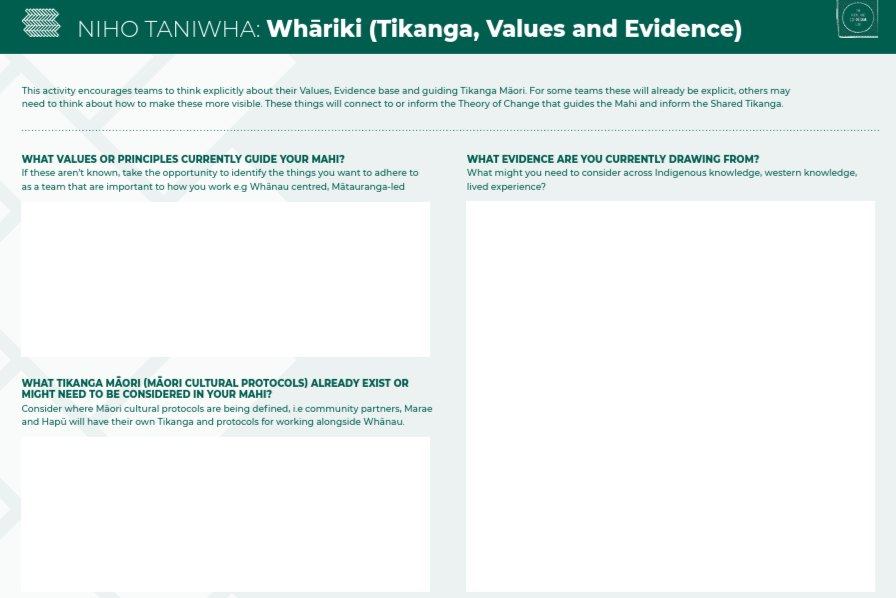
The Whāriki is the foundation of the Niho Taniwha framework, it symbolises the intentional weaving together of Tikanga Māori, Values and evidence to ground teams in a shared purpose and provide strong foundation for practice.
Practices and activities within Te Whāriki encourage teams to think explicitly about their values, beliefs, evidence base and the tikanga Māori that guides them. For some teams these will already be explicit, however others may need a deeper collective exploration of these elements.
Each Whāriki will be different depending on the context, however establishing a shared Whāriki is an important first step to give transparency to the different knowledges, worldviews and practices that underpin action and decision making.
The collective ‘weaving’ of your Whāriki is one of the first steps of embedding a Niho Taniwha learning system into your mahi. The following resources provide guidance on to get started.
-
This activity is often used when facilitating a Whāriki session. It is not in the Practice Guide, so we’re sharing it here for you to try with your own team.
What you need
Strips of paper [in a few colours, if you like]
Pens
How to do it
Hand out strips of paper to each person.
Invite everyone to write the core values that guide their mahi onto their strips of paper.
Share the values around the group, and talk about what each one means to you.
Weave the strips together so the values interlock.
Talk about what you see - together, reflect on what you’re noticing, what is surprising or unexpected and what is different.
What you end up with
An artefact for your project, team or kaupapa that you can revisit, add to or adjust as your mahi grows.
A tangible manifestation of your Niho Taniwha Whāriki.
-
An introduction to Te Whāriki
Niho Taniwha Symposium Presentation

Te Whāriki Practice Guide
Te Whāriki Template


Wāhi Ako Tuatahi
In-place Learning
Active learning with whānau and kaimahi across multiple places/sites.
Wāhi Ako Tuatahi grounds us in the realities of people and place. It represents the action and learning generated alongside sites and whānau on the ground through specific prototypes or initiatives.
Within this first level of learning, we pay attention to what whānau and communities say matters most, honouring their lived experience and voice.
Wāhi Ako Tuatahi is the foundation to place-based learning.

Wāhi Ako Tuatahi Practice Guide


Wāhi Ako Tuarua
Collective Learning
Active learning with kaimahi across place and system.
Wāhi Ako Tuarua brings together collective learning from across Wāhi Ako Tuatahi prototypes or initiatives. It is a space to surface learning around how systems, practices, processes or policies can be better designed to enable outcomes and aspirations of whānau.
Wāhi Ako Tuarua Practice Guide


Wāhi Ako Tuatoru
Systems Implications
Active learning with kaimahi with influence over systems levers and conditions.
At this level, the focus is on exploring how changes identified from the collective learning at Wāhi Ako Tuarua can be tested or actioned at a systems-level to create better outcomes for whānau.
Wāhi Ako Tuatoru Practice Guide
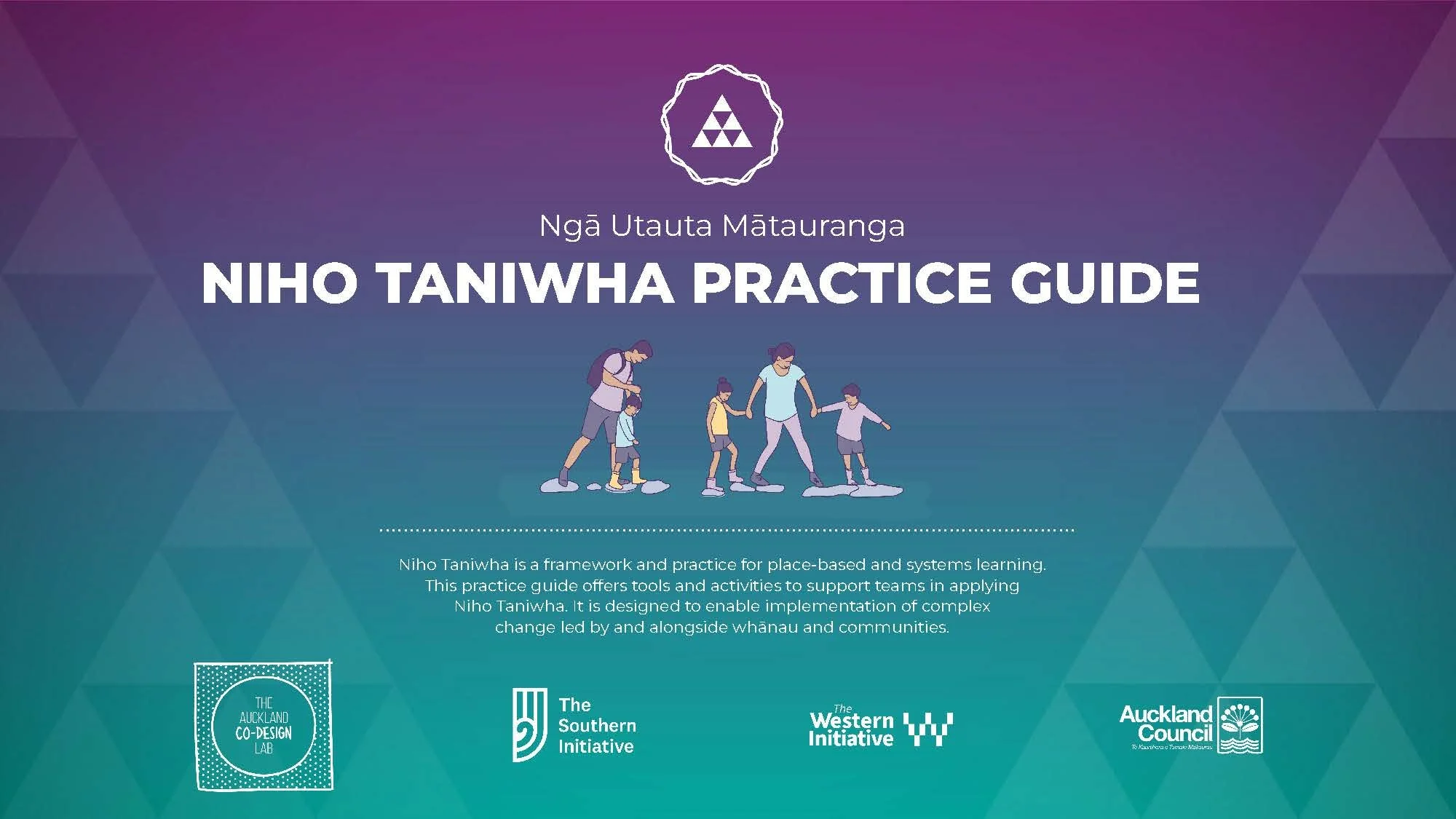
Practice Guide
Nau mai ki Ngā Utauta Mātauranga o Niho Taniwha
This Practice Guide offers a range of tools and activities to support teams in applying the Niho Taniwha framework within their mahi.
Tools are mapped against Te Whāriki, Wāhi Ako and across the framework as a whole. Some tools include activity templates which can be downloaded below.
Explore Niho Taniwha
-
Learn about the whakapapa of Niho Taniwha and how it came to be.
-
Build your understanding of Niho Taniwha through the following resources:
Niho Taniwha Overview: A slide deck introducing the key elements of Niho Taniwha.
Niho Taniwha Introduction: A comprehensive exploration of the framework, its purpose, key elements and what it supports us to do.
-
Guidance, tools and templates to support teams applying the Niho Taniwha framework including:
Downloadable practice guides and templates
The Niho Taniwha Practice Guide
Practice advice for Te Whāriki and each Wāhi Ako
Guidance to help you decide if Niho Taniwha is suitable in your context and how to get started.
[LINK]
-
See how teams across Aotearoa are using Niho Taniwha in their mahi, through case studies and recorded presentations.
[LINK]
-
Join the Niho Taniwha Learning Network for support, shared learning and practical examples from others applying Niho Taniwha.
[LINK]